In the month of June this year a few keen folk and I ventured out as Forest Church for a late evening walk on Whitmoor Common. There were a couple of highlights for me that evening.
This time of year there is often an expectation due to the season of seeing nightjars (Caprimulgus europaeus). In previous years they have been seen on Whitmoor. We were well prepared. Having for a number of years scouted the site there are a few specific spots the nightjars frequent one of these spots did not disappoint.
We were well into dusk when we approached the end of the track where there is a ‘T’ junction. This is when we heard the churring. Earlier on beside the other side of the railway track we had heard one in the distance but this was much closer.
All of sudden there about 3 metres from us one hovered in full view for everyone to see. It was unperturbed by our presence – it was like it was showing off. Prior to this another one had flown close by and we saw it land on a nearby tree. As we moved away pondering the moment, we had gone over the railway bridge and two more flew together over our heads at house height, after calling to alert us to their presence. Both of these were special moments.
The other species which had our attention was the Pipistrelle (Pipistrellus sp). By the railway line there is a section of high birch trees where I have seen them in previous years. They were there again and later by Brooke Pond. I had my bat detector with me which made the experience more tangible. (NB. There are three species of Pipistrelle in this country the common (pipistrellus), soprano (pygmaeus) and narthusius (nathusii) all of which I’ve heard have been recorded on Whitmoor Common. I am not able to detect the difference with my detector currently).
In August we had another Forest Church gathering. I was in the process of reading a poem about birds and how they can teach us. I had my back to the open common and I saw one of the participants react but not to the poem! He hadn’t wanted to interrupt. As soon as I finished I found out why he had reacted. We all turned to see a bat flying out in the open. It was feeding in a different way to pipistrelles and was larger than a pipistrelle. I pointed the bat detector at it and for the first time the sounds emitted by the detector were very different to what I’ve had before. I have had some subtler sound differences but this was quite different. Later I confirmed my suspicions but at the time I went with it that the bat was a noctule (Nyctalus noctula) The bat detector emitted the characteristic chip-chop sound which is more slower than the pipistrelles ‘chattering’. (NB. The recording above uses a different style of sound pick up. The bat box baton I use operates by frequency modulation)
I have heard that one of our other large bats has been recorded in the past on Whitmoor Common – the Serotin (Eptesicus serotinus). This one flies more closely around shrubs and plants and less likely to be in the open also the sound that it makes wasn’t like what we picked up. Scroll down the page linked to hear the Serotin on a heterodyne bat detector.
This was a magic moment and was accentuated by a pipistrelle coming out not long after and the sound of an incessant bush cricket in the background too, picked up by the bat detector. When they had both disappeared and the sound of the cricket had died away a nightjar called elusively. It wasn’t until much later after checking out the site where we had seen the June nightjars we went back to the same spot where we’d seen the noctule. The nightjar flew towards us through the gloaming on a glide without hardly flapping its wings. We had our torches out as it was nearly dark and as it turned above us and flew over the trees we caught the beautiful cryptic plumage markings, the white spots and the light reflecting from its eyes. What a moment!
It wasn’t until the next day when reporting back to the rest of the Forest Church group about the event, those who couldn’t make it, did I remember another time. One evening back in the late 90s I was sitting under a bush on another part of the common looking out to the open area where I sat still. I suddenly felt something, the vibrations of sound from echolocation, simultaneously I looked up to see a noctule bat flying by. I knew from the form of flight having seen one over the Basingstoke Canal years earlier that it was a noctule. They fly in a straight line often and then drop to catch prey.
Not all my nature experiences of awe happen when at Forest Church but the awe is greater when experienced with a group. I was chatting with one of my clients as I was finishing work and a butterfly landed an arms length away and my excitement rose. The shape and markings spoke to me of a hairstreak.
In this country we have the green (Callophrys rubi), purple (Favonius quercus), white letter (Satyrium w-album) and the black hairstreak (Satyrium pruni). I wasn’t so familiar with this one which was neither of these. I had a hunch which proved to be correct. The moment didn’t last long as often nature moments don’t. It flew off quite quickly but I clearly saw the markings and memorised them. The underside of the wing markings were a range of different rich oranges with white streaks. The little bit on the back of the wing near the wing base was very clearly obvious as well.
Again seeing it was experienced with another person who I think appreciated something rare being in her garden. The butterfly was a brown hairstreak (Thecla betulae). It was likely to have been feeding on the nearby tall oaks.
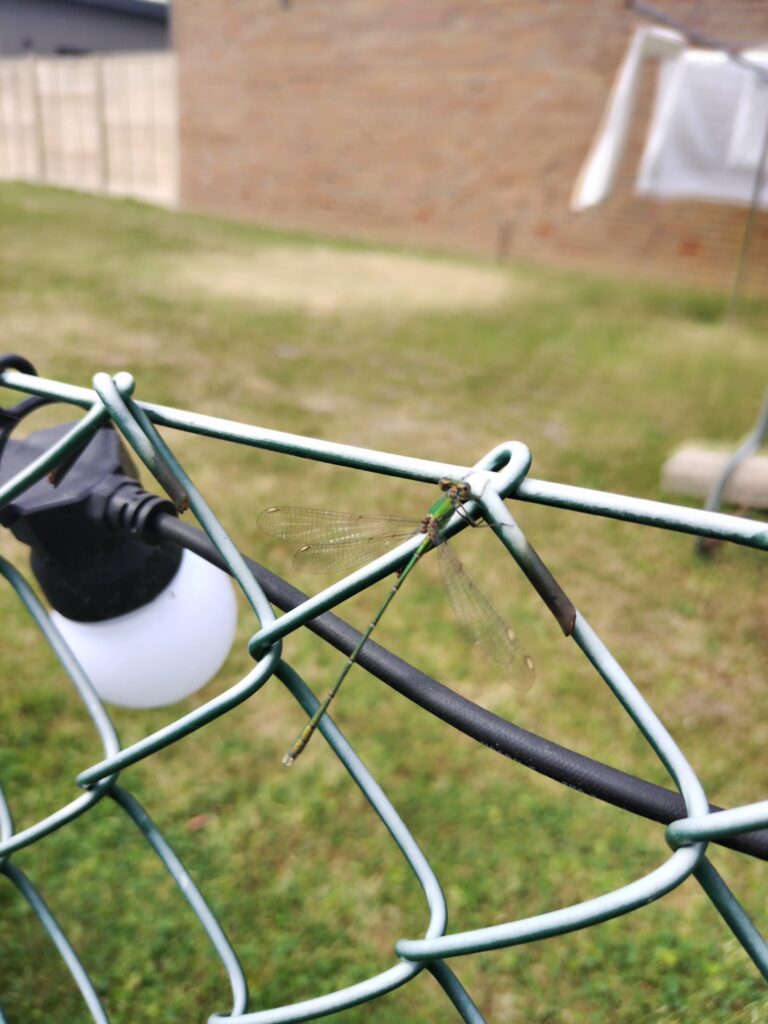
Yesterday while entertaining family in the garden under our Coleman canopy we had a visit from a damselfly. Our garden is mainly lawn but we do have a border (see earlier garden blog). The damselfly could easily have been missed as it was very slight and camouflaged against the green of the grass. I don’t recall Identifying this species before but it was exciting to find and that it’s not particularly common and has spread from East Anglia. No mention in my dragonfly book of being seen in gardens from what I remember. It was a Willow emerald (formerly Lestes viridis now Chalcolestes viridis)
For an extra bit of bat blogging from another blogger see this Edinburgh Botanical garden visit.
If you’d like to read more about other nature experiences with bats, nightjars or other nature interests try using the blog search engine within connect3ways.co.uk and see what comes up.