On waking up I thought one morning – am I being intentional with my life? I was thinking about the Three Circles and people’s approaches to what their world is about, Someone from church shared with us the Disciple Making Movement (DMM) approach which was also in my thinking and then I thought of Bible Project which is a big movement now. What about me? I thought? How do I live? What do I bring to the world? I couldn’t help but have the thought about the trumpet come back to me. This was a gift I was given in my early 20s and have been reminded of it recently. This isn’t a real trumpet but a metaphorical spiritual one.
We are going to explore here where the shofar or trumpet came into the Biblical story and what it’s conveying and how it relates to us.
I did a quick look up in Google when does the word trumpet first occur in the Bible. As I read a small section I saw there, what came into my mind was that there was a sound from heaven first. This is how it started. Isn’t that how it always starts? Isn’t that the point, to hear from heaven first and then go do what that sound makes?
The trumpet or shofar is referenced in various biblical contexts, including worship and ceremonies (Numbers 10:2; Leviticus 25:9 for Jubilee), signalling events and gathering God’s people at Sinai (Exodus 19:13, 16–17), and in praise before the king (Psalms 98:6), among others noted in Old and New Testament narratives.
Ecosia Overview
Interesting that as I look at the passage where the trumpet is referenced, Moses is called up the mountain. Exodus 19.3 The word called speaks to me. This is one of the purposes of a trumpet. This is a word I’ve been considering recently. The Hebrew word has various meanings:
- Shout
- Summon
- Appointment
- Name
- Proclaim
- Announce
- Recite
- Read
The Septuagint LXX (The Greek version of the Old Testament) has 467 occurrences of this word.
Moses went up to God and God called to him from the mountain……this you will say to…you will tell…
Exodus 19.3 LEB
And now if you will carefully listen to my voice and keep my covenant, you will be a treasured possession for me out of all the peoples, ⌊for all the earth is mine⌋, but you, you will belong to me as a kingdom of priests and a holy nation.’ These are the words that you will speak to the ⌊Israelites ,
The Israelites hadn’t even been given the law but they were willing to be obedient and listen. The bit about trusting in Moses forever is quite striking. The next two verses is hyperlinking to Jesus. The people had to be made ready to come to God and wash themselves. Jesus does this in the new covenant which the old was foreshadowing and it’s done over three days.
And Yahweh said to Moses, “Go to the people and consecrate them today and tomorrow. They must wash their clothes, and they must be prepared for the third day, because on the third day, Yahweh will go down on Mount Sinai before the eyes of all the people
This is serious stuff in how the people were to approach God. It was on His terms and this is when the trumpet is first mentioned. We can extrapolate what was for the Israelites and apply this for our day. You can only go up the mountain of God when the trumpet blasts. This is when you’ve been made ready. Jesus now has made us ready to go up the mountain of the Lord. The everlasting gospel is being proclaimed by His angel.
Not a hand will touch it, because he will certainly be stoned or certainly be shot; whether an animal or a man, he will not live.’ At the blowing of the ram’s horn they may go up to the mountain.”
And on the third day, when it was morning, there was thunder and lightning, and a heavy cloud over the mountain and a very loud ram’s horn sound, and all the people who were in the camp trembled
Reading the next bit is really striking; how awesome and terrifying this must have been! When I read it I could hear it as from afar. If a mountain shakes it’s not a localised event. The surrounding people of other nations must have heard and felt this too!
And⌋ on the third day, when it was morning, there was thunder and lightning, and a heavy cloud over the mountain and a very loud ram’s horn sound, and all the people who were in the camp trembled. And Moses brought the people out from the camp to meet God, and they took their stand at the foot of the mountain. And Mount Sinai was all wrapped in smoke because Yahweh went down on it in the fire, and its smoke went up like the smoke of a smelting furnace, and the whole mountain trembled greatly. And the sound of the ram’s horn became ⌊louder and louder⌋, and Moses would speak, and God would answer him with a voice
As I read that I couldn’t help but think of the book of Hebrews:
For you have not come to what may be touched, a blazing fire and darkness and gloom and a tempest and the sound of a trumpet and a voice whose words made the hearers beg that no further messages be spoken to them
Interestingly there is a contrast with what took place recorded in Exodus 19 and it’s that you’ve (plural) now come to a festal gathering not to a terrifying shaking mountain.
But you have come to Mount Zion and to the city of the living God, the heavenly Jerusalem, and to innumerable angels in festal gathering, and to the assembly of the firstborn who are enrolled in heaven, and to God, the judge of all, and to the spirits of the righteous made perfect, and to Jesus, the mediator of a new covenant, and to the sprinkled blood that speaks a better word than the blood of Abel.
This is the only time the Greek panegyris is mentioned in the NT – festal gathering.
The blowing of… The Israelites do not produce the trumpet sound; the sound emanates from the mountain and God’s presence (see Exod 19:16, 19; compare Zech 9:14). References to a divine trumpet call in the NT draw from this context (compare Matt 24:31; 1 Cor 15:52; 1 Thess 4:16). The NT writers also align the trumpet sound with the voice of the risen Christ or angelic beings (1 Thess 4:16; Rev 1:10; 4:1). However, musical instruments are also spoken of in heavenly visions in the NT (Rev 8).
Faithlife Study Bible
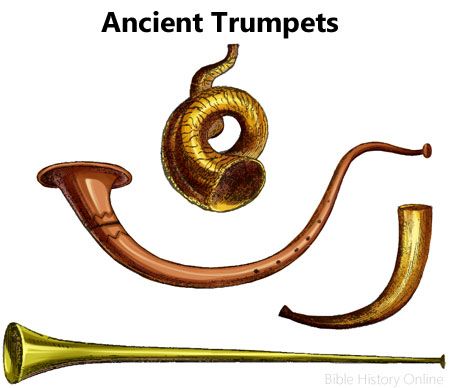
Biblical trumpets:
חֲצֹצְרָה (chatsotserah); “”—a straight horn made of silver used to summon the people of Israel and to praise the Lord (Num 10:1–10; Psa 98:6). The term is likely onomatopoeic—meant to mimic the pulse sounds produced by the horn. Josephus describes the instrument this way: “In length it was a little less than a cubit. It was composed of a narrow tube, something thicker than a flute, but with so much breadth as was sufficient for admission of the breath of a man’s mouth: it ended in the form of a bell, like common trumpets” (Antiquities 3.12.6). The trumpet had no valves or finger holes, and it could play only a limited number of pitches. It was used to sound alarm or signal the beginning of celebrations (Num 10:8–10; 2 Chr 13:12, 14; 29:27; Ezra 3:10).
קֶרֶן (qeren); “horn”—a trumpet-like instrument likely made from the horn of an animal; often used to describe a literal animal’s horn or a horn manufactured to carry oil (Dan 8:5; 1 Sam 16:13). This was a loud musical instrument used in battle (Josh 6:5). It could play only a limited number of pitches, however, and was not used to accompany singing.
שׁוֹפָר (shophar); “” or “”—the turned-up horn most commonly used in Israel. It was used on military and religious occasions, most likely to signal an event rather than to accompany (Josh 6:4; Judg 7:16; Num 10:10; 1 Sam 13:13). It could play only a limited number of pitches—probably the tonic and the fifth—and its tone was loud and piercing. It is the only instrument of ancient Israel still used today in Jewish liturgy (Sellers, “,” 43).
Σάλπιγξ (salpinx); “trumpet”—a ram’s horn; used to metaphorically signify a loud pronouncement or to designate an actual instrument (Matt 6:2; 1 Cor 14:8). Matthew 24:31 and Heb 12:19 translate שׁוֹפָר (shophar) from Isa 27:13, indicating that the Greek term refers to this common ram’s horn. It is used most often to describe the “last trumpet” or trumpets played by angels in heaven (1 Cor 15:52; 1 Thess 4:16; Rev 8–11). LBD Lexham Press.
Whilst thinking of sharing something with the Church at Four group I am involved with, I was struck by the phrase ‘blowing your own trumpet‘ how that has come to mean showing off and I wondered if that’s what God wants me to do! It goes against my Christian thinking but he wants me to live in freedom not being held back by ‘shyness’. I am an introvert and I find it uncomfortable to show-off or even share a word or the work that I have done e.g. writing a blog or creating a website.
Have I over spiritualised the trumpet gift?! Should I be boasting? How am I boasting? What am I boasting in? If I do boast who am I doing that in or for?
Something else I’m pondering is the fact that the trumpet sound that came from heaven was not of men’s origin. The Lord was blowing his trumpet(s). As I’m made in his image do I also get to declare glory by blowing a trumpet? All I have is from him. I can’t boast in anything else apart from him. He’s given me everything. The glory needs to go back to him. Claiming back something religion has stolen from the people of God. We all have gifts and talents we can use them to declare his praise. In effect are we blowing a trumpet by doing that?!
“Let the one who boasts, boast in the Lord.” For it is not the one who commends himself who is approved, but the one whom the Lord commends.
For consider your calling, brothers, that not many were wise according to human standards, not many were powerful, not many were well born. But the foolish things of the world God chose in order that he might put to shame the wise, and the weak things of the world God chose in order that he might put to shame the strong, and the insignificant of the world, and the despised, God chose, the things that are not, in order that he might abolish the things that are, so that all flesh may not boast before God. But from him you are in Christ Jesus, who became wisdom to us from God, and righteousness and sanctification and redemption, so that, just as it is written, “The one who boasts, let him boast in the Lord.”
As I consider this for the article I have an old kids song come to me. If I were a butterfly…thank you Lord for making me, me! Does it means that we shouldn’t say we’re good at something? Or be proud about what we do? For me the trumpet that I saw is a symbol, a reminder of the good things that God has given me. They are not to be kept to myself but to be shared. This is why I write what I write.
Postscript
Not long after writing this post a lot of pressure was taken off me in regards to trying to operate in this ‘gift of the trumpet’. I had some fresh revelation about freedom which I write about in an upcoming post. The trumpet that has been given to me is a symbol of the Lord himself. It is a beautiful picture of someone I can rely on when needing rescuing. One of the characters within the Narnia Chronicles gets given a horn to blow when rescue is needed. The horn often appears in other stories too.
In Psalm 18.2 (2 Samuel 22.3) Yahweh is described as:
- being my rock (twice)
- my fortress
- my God
- my deliverer
- my shield
- the horn (qeren) of my deliverance/salvation (Luke 1.69)
- my stronghold.