What is done you may ask? This is a piece about this phrase and what it is conveying. Firstly I write about how it came to my attention.
I had one of my strange picture dreams.
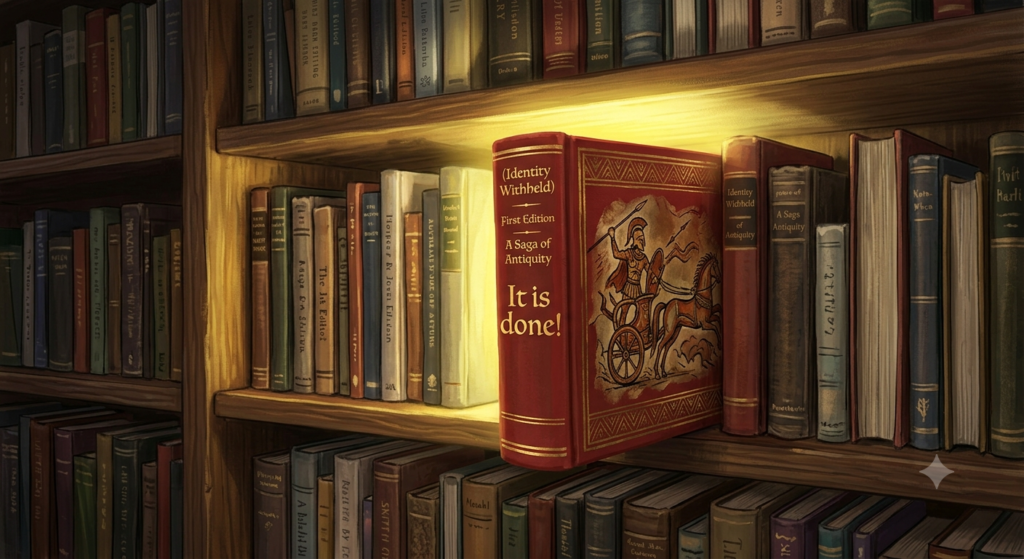
I saw a bookshelf with books. One shelf was highlighted and one book was pulled out with a red coloured dust jacket and gold illustration and text on it. I heard the authors name spoken, (identity withheld) was the name I heard as I looked at the book. There was quite a bit of text on the spine. The illustration was of an ancient warrior with or on a chariot, in a particular style, somewhat like advanced cave art and the book title was “ It is done!” I did not see the title I heard it or saw it separately. It was quite a thick book. I also heard almost simultaneously “It is finished!” When I saw the book I believed it was an actual book! I had a strong sense I needed to read this book.
An interpretation of my text in visual form (not quite how I saw it but gives you a sense of what I saw)
The part where it says it is finished occurred to me in the dream as stated. In Greek the phrase that is used is tetelestai. This is the phrase that Jesus uses on the cross when he is crucified. When I look up the actual phrase (although I did have both) there are two specific uses of the phrase and they’re both here:
Revelation 16:17 LEB
And the seventh poured out his bowl on the air, and a loud voice came out of the temple, from the throne, saying, “It is done!”
Revelation 21:6 LEB
And he said to me, “It is done! I am the Alpha and the Omega, the beginning and the end. To the one who is thirsty I will give water from the spring of the water of life freely.
I’ve also included the other phrase but in a different translation to get the full nuance.
John 19.30 CSB
Then when he had received the sour wine, Jesus said, “it is completed!” and bowing his head, he gave up his spirit.
I’m thinking that the author of the dream book could well have been Jesus but that wasn’t what struck me the most. It was the fact that the book was pulled out figuratively saying to me, take a look at this book and the title. This is what you need to pay attention to. The illustration was supportive of what was happening with the title.
Something on the illustration is that it depicts an ancient battle that has been going on. Interesting that the colour of the jacket was red which is of blood which I can’t get away from.
For grammar nerds I lifted this from the internet:
The Greek word **tetelestai** is parsed as a **perfect passive indicative,
Google AI
third-person singular** verb from the root *teleo*,
meaning “to bring to an end, finish, or complete.”
For more about the phrase tetelestai I recommend Precept Austin who has written a lot about it here. For this blog I am focussing more on the main phrase it is done.
The old order has been dealt with, no longer do the evil powers have authority behind the scenes to pull the strings. The ultimate victory belongs to Jesus Christ.
Interestingly the first reference of it is done is in the context of the seventh bowl of God’s wrath being poured out. This was the last bowl. So it makes sense that it says it is done.
In the second reference it is in the light of making all things new and the perspective is from a heavenly one as the text is in the section where the writer speaks of the one who is seated, both a symbol and a reality.
Both phrases are written in the past about something that is happening in the future, yet they both say it is done (gegonan perfect active indicative verb).
The price is paid,
Come let us enter in
To all that Jesus died
To make our own
For every sin
More than enough He gave
And bought our freedom
From each guilty stainThe price is paid
Alleluia
Amazing grace
So strong and sure
And so with all my heart
My life in every part
I live to thank You for
The price You paidThe price is paid
See Satan flee away
For Jesus crucified
Destroys his power
No more to pay
Let accusation cease
In Christ there is
No condemnation nowThe price is paid
And by that scourging cruel
He took our sicknesses
As if His own
And by His wounds
His body broken there
His healing touch may now
By faith be knownThe price is paid
‘Worthy the Lamb’ we cry
Eternity shall never
Cease His praise
The church of Christ
Shall rule upon the earth
In Jesus’ name we have
AuthorityGraham Kendrick
Copyright © 1983 Thankyou Music
This book has been pulled out, drawing my attention to it for a reason. I’m thinking about the topic of this dream book, about victory through Christ and how this connects to my life and all that’s gone before. And for all you readers for that matter.
I looked up to see if there was any artwork historically like the illustration on the book. There’s a tiny sculpture of two people in a chariot driver and warrior found in Tajikistan dated around 3 – 5BC which is in the British Museum. This artefact bears some resemblance to what I saw.
A horse is prepared for the day of battle,
but to Yahweh belongs the victory.
Ancient warrior came to my mind when considering the dream. This phrase draws on the Biblical divine warrior motif and the Ancient of Days passage. For more detail on the divine warrior motif read here.
The blurry bit on the spine in the dream is important and should not be ignored because it’s blurry. It’s because it’s blurry it’s significant.
The spine is the backbone of a book. The backbone is part of the body that stabilises the whole body and keeps it upright. The fact that I noticed that the spine has a lot of text on it was important. Even if I could not read the text. Sometimes words that we see, don’t understand, or even images we don’t understand in a dream are an invitation to look beyond our lack of knowledge to explore what is being said or shown.
The other point I was considering about the spine is that’s where you can see who the author of a book is. The author is the one who’s created the book and has a vested interest in conveying a message whether that’s a fiction book or a non-fiction book.
The fact that I heard or saw a person who’s identity is withheld is also important. I can’t deny that. Dreams don’t lie. The identity withheld person is obviously important. I didn’t see the person I only heard their name. What’s in a name? A name tells you about what a person is like. A name in the Bible often conveys reputation.
The person who’s identity is withheld has this meaning > Sky/shine Father, Man of vigour, strength or force.
Pay attention!
Would a book be marketed or sold with such scrambled spine detail where no one is able to understand it?! It might make you pick the book out as you wonder what on earth is going on?! Why has such a book been marketed?! That’s the point. Take hold of the book to look. In this case the book is already pulled forward and you can see what is happening on the book jacket front cover. A point I’ve not highlighted before is that the book jacket cover does not have text on it, only an illustration.
At this juncture I thought it would be good to ask what in Christian thought, the Bible and theology is a dream conveying? A helpful answer from a search asking this question. Answer in italics:
In Christian theology, a dream is primarily understood as a medium for divine communication, where God conveys guidance, warnings, prophetic revelations, or spiritual encouragement. While not all dreams are considered spiritual, Christian thought generally categorizes meaningful dreams into three main types of messages:
• Divine Guidance and Instructions: God often uses dreams to direct people’s actions. For example, in the New Testament, an angel appeared to Joseph in a dream, telling him to marry Mary and later instructing him to flee to Egypt to protect the infant Jesus.
• Warnings and Correction: Dreams can serve as a divine intervention to stop someone from making a mistake. In the Old Testament, God warned the pagan king Abimelech in a dream not to touch Abraham’s wife, Sarah.
• Prophetic Revelation and Strategy: Some dreams reveal future events or provide supernatural insight. Joseph (son of Jacob) and Daniel both received and interpreted prophetic dreams that shaped the geopolitical futures of Egypt and Babylon. Key Theological Principles
• The Need for Discernment: Christian theology emphasizes that not all dreams are from God; they can also stem from natural human anxieties or spiritual deception. Therefore, dreams must always be tested against the Bible and spiritual wisdom.
• The Role of the Holy Spirit: In modern Christian thought—drawing from the New Testament book of Acts—the widespread occurrence of spiritual dreams is viewed as a continuous work of the Holy Spirit in the lives of believers.
I think the dream is a revelatory encouragement dream reminding me what Jesus has done and continues to do in my life. There’s a possibility that this book is also a warning as the colour of the book is red. I think it is red to draw attention to it as red is a strong colour. Red in my initial thought was to do with blood. The blood has been shed by the divine warrior on our behalf. Jesus came from his Father who is in the heavens. He was and is and is to come the God-man. He died in the cross, he rose again and he ascended into heaven – all in three days. That’s the earthly perspective. He is now reigning in and from heaven.
To us from our perspective it doesn’t look like it is done but the words which were spoken in the dream which I heard/saw declared that it is so. Often in scripture we are exhorted to set our eyes on things above and not conform to the standards of this world and so forth.
And the one seated on the throne said, “Behold, I am making all things new!” And he said, “Write, because these words are faithful and true.” And he said to me, “It is done! I am the Alpha and the Omega, the beginning and the end. To the one who is thirsty I will give water from the spring of the water of life freely. The one who conquers will inherit these things, and I will be ⌊his God⌋ and he will be ⌊my son⌋ (Revelation 21:5–7, LEB)
Wow!
As I consider the emotion of the dream, there was a feeling of satisfaction and fulfilment. Like the picture of a man leaning back after a good meal and holding his belly, not through over consumption but by having all he needed.
There is a sense of contentment with this. Godliness with contentment is great gain.
In my late twenties I was inspired to come up with a tune for a scripture. The scripture is from Ecclesiastes and it relates to what I’m writing about here. The text speaks of what God does. I’ll let it speak for itself – or should I say sing for itself! Ecclesiastes 3. 14,15
I find it intriguing that the word for spring in Greek used in the Revelation 21.6 reference can also be:
- The well of the water of life
- The fountain of the water of life
The Greek word for spring is pēgē as we see below it can also mean haemorrhage. As in the woman who had been bleeding for a long time.
The word spring or what’s behind this word occurs 11 times in the New Testament (note the first meaning which is different).
Mark 5:29
And immediately her hemorrhage stopped and she realized in her body that she was healed of her suffering.
John 4:6
And Jacob’s well was there, so Jesus, because he had become tired from the journey, simply sat down at the well. It was about the sixth hour.
John 4:14
But whoever drinks of this water which I will give to him will never be thirsty for eternity, but the water which I will give to him will become in him a well of water springing up to eternal life.”
James 3:11
A spring does not pour forth from the same opening fresh and bitter water, does it?
2 Peter 2:17
These people are waterless springs and mists driven by a hurricane, for whom the gloom of darkness has been reserved.
Revelation 7:17
because the Lamb who is in the midst of the throne will shepherd them and will lead them to springs of living waters, and God will wipe away every tear from their eyes.”
Revelation 8:10
And the third angel blew the trumpet, and a great star burning like a torch fell from heaven, and it fell on a third of the rivers and on the springs of water.
Revelation 14:7
saying with a loud voice, “Fear God and give him glory, because the hour of his judgment has come, and worship the one who made the heaven and the earth and the sea and the springs of water!”
Revelation 16:4
And the third poured out his bowl on the rivers and the springs of water, and they became blood.
Revelation 21:6
And he said to me, “It is done! I am the Alpha and the Omega, the beginning and the end. To the one who is thirsty I will give water from the spring of the water of life freely.
A spring is an opening in the ground where water gushes up from. A fountain is also an opening but the pressure is greater so more water comes out faster and upwards. And a well is a deep opening where water collects and can be collected.
The dream book is about a battle. The Divine Warrior is at work from ancient of days and has fulfilled his purpose.
Reading in the notes of the Faithlife Study Bible, I see some great links to the old testament, specifically Psalm 22 which is in the notes for John 19:30.
It is completed Jesus knows that God’s plan for Him has reached its completion—He has done what He came to earth to do (compare John 17:4–5).This is likely a citation of Psa 22 (see note on Psa 22:31; note on Psa 22:30–31). Jesus is claiming that He is the ultimate sufferer for God’s people
Faithlife Study Bible. Bellingham, WA: Lexham Press.
This bit in Psalm 22 caught my attention as I don’t ever remember reading this phrase of the verse which is highlighted in the portion below. Maybe because we focus more on the earlier part of Psalm 22:
All the ends of the earth will remember and turn to Yahweh.
All the families of the nations will worship before you.
Because the kingship belongs to Yahweh, and he rules over the nations.
All the ⌊healthy ones⌋ of the earth will eat and worship.
Before him all of those descending into the dust will kneel, even he who cannot keep his soul alive.
Descendants will serve him.
Regarding the Lord, it will be told to the next generation.
They will come and tell his saving deeds to a people yet to be born, that he has done it.
Psalm 22:27–31 LEB
Psalm 22:31 he has done it: The Hebrew phrase here, ki asah, can be understood as “for it is done.” Jesus may have had this verse in mind when he said “It is finished” (tetelestai in Greek) as He died on the cross (John 19:30).
Faithlife Study Bible. Bellingham, WA: Lexham Press.
And finally at this point there is a reminder here of Hebrews 12 where the author writes about Jesus as the originator, or author and finisher of the faith. (See some of the other words for originator or finisher here which are translated differently).
What does this mean for me or for you? It means we have confidence that what Jesus says he will do, he will do! Our job is to persevere in the fight which is not against flesh and blood (Jesus said love your enemies and pray for those who hate you – Matthew 5 – 7) but against the spiritual hosts of wickedness in the heavenly places. In other words the unseen realm. You can read more on that if you do a search on this website using that phrase.
Jesus said to his disciples and by extension that’s a disciple today too:” I have given you authority to trample on snakes and scorpions and to overcome all the power of the enemy“.
Two other things I haven’t mentioned. The first is about the restoration of all things which appears in the Revelation 21 passage. As the words there state it is done, does this not also include everything that he made in the first place? Not only is humanity included in that statement of behold I am making all things new but also the whole of creation. Don’t you want to be a part of that? I have written on that elsewhere on this website.
For a while I thought that where it says,
The one who conquers will inherit these things, and I will be his God and he will be my son. (Revelation 21:7, LEB)
that it was refering to anyone who conquers which would require effort, which means a works based salvation. I am not sure this is the case. I think the language is gender specific for a purpose here.
When we accept Christ into our lives and have a living relationship with him we become included in him. Jesus is the one who continuously conquers or overcomes. I wonder if it’s another way of saying that. This idea needs to be checked out against scripture especially in the light of the latter part of the verse, where the Lexham translation has notes where it could be read like this:
I will be to him God and he will be to me a son.
This concept is a whole topic or theme in itself which is probably above my pay grade! (For more on that if you’re interested. Ask this in italics in a Google search and welcome to a large rabbit hole: son of God theology Heiser amd mormonism) All I can say here is, Jesus is the unique son of God and he is God as I alluded to earlier.
I can’t help but finish here with Colossians 1.9-23 with a highlight on verse 17. (This is difficult to do as this whole passage is loaded – and one very long sentence!)